Budweiser Lager Beer 12 Oz Tab Top Can
Anheuser-Busch • Merrimack, NH
Budweiser Nine-City Steel Tab Top
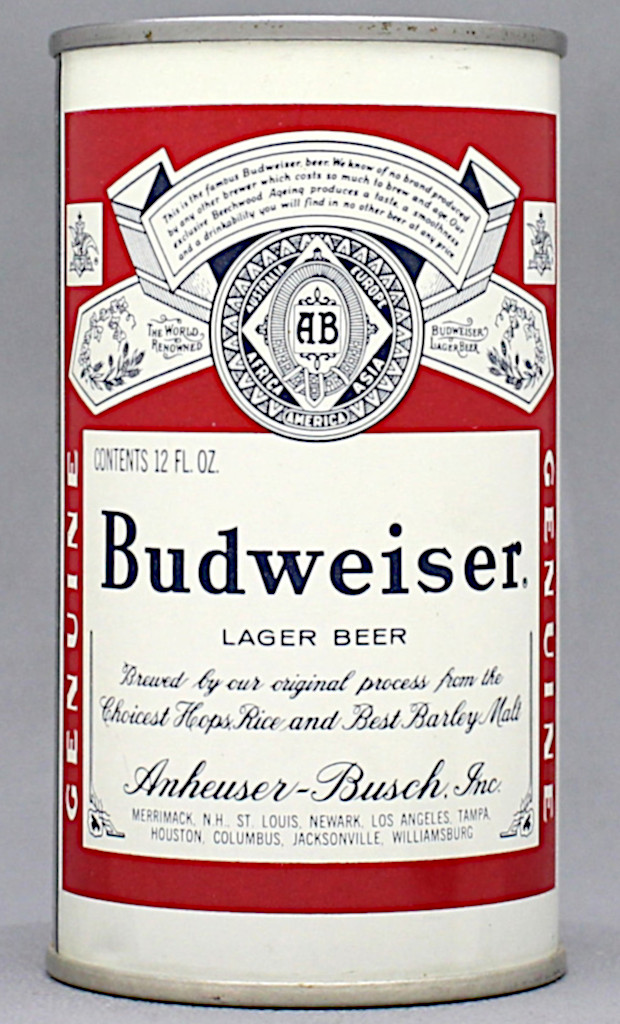
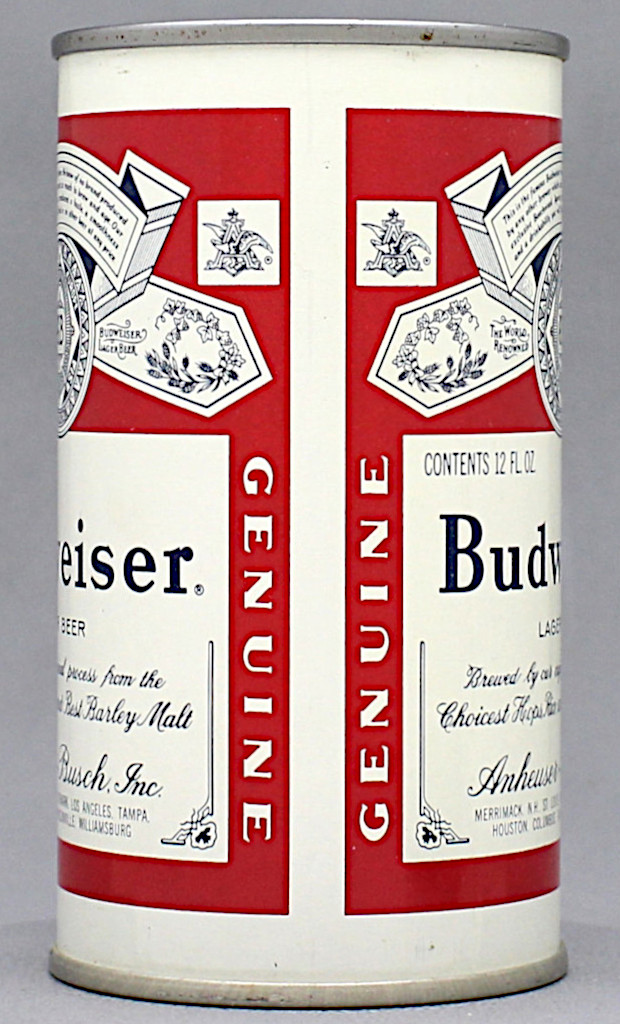
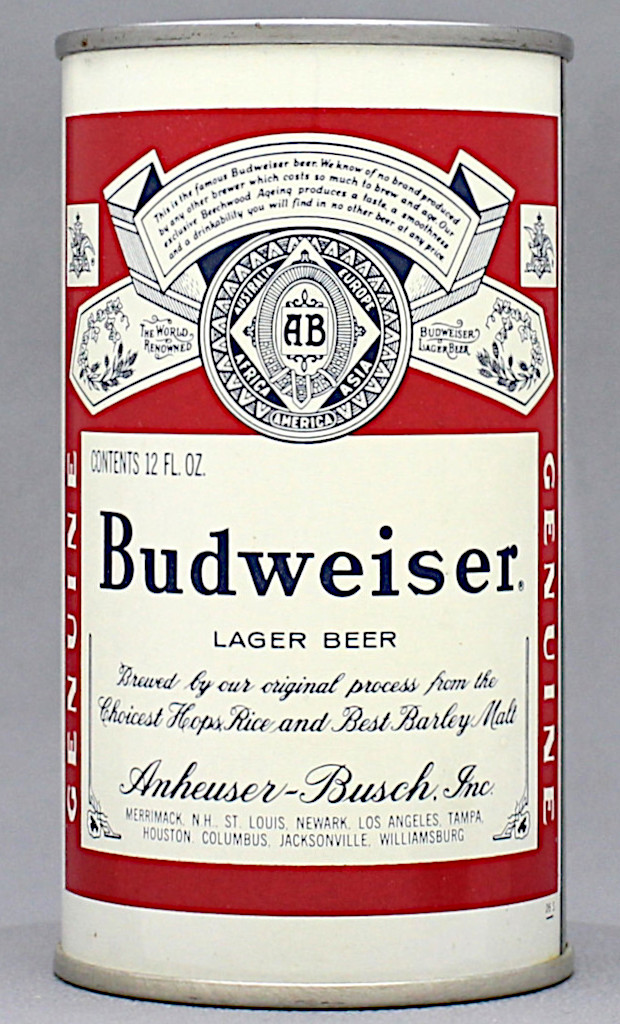
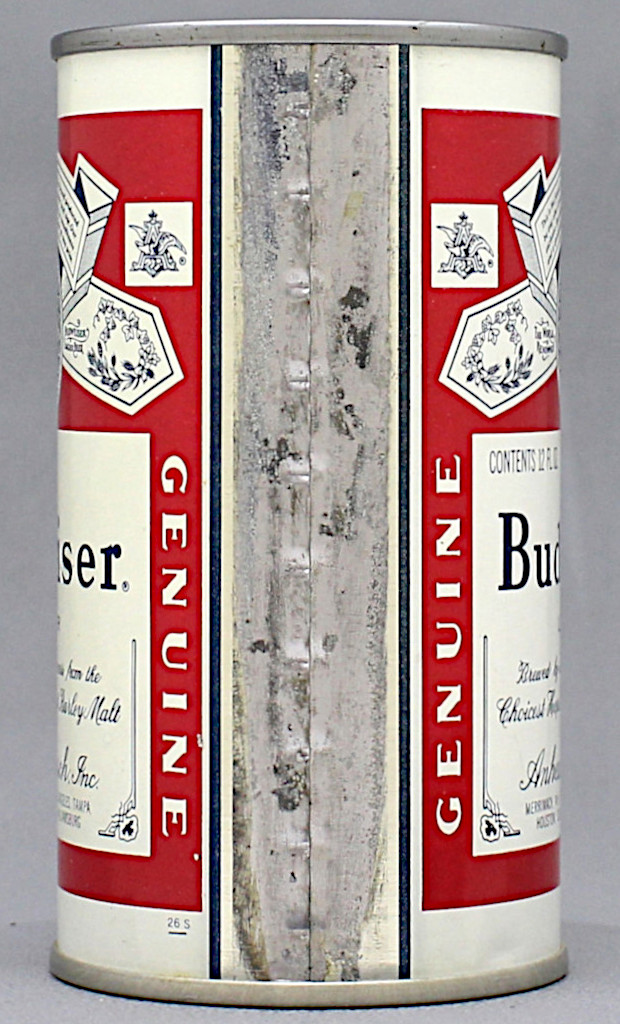
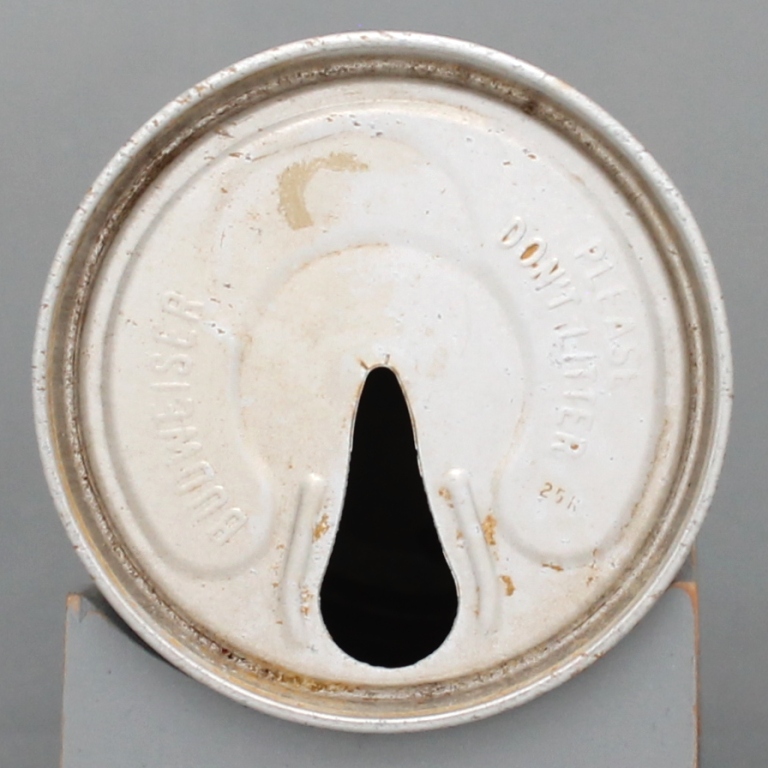
This straight-steel tab top can dates to the early 1970s, a period defined by rapid national brewery expansion and evolving beverage packaging. The face displays the traditional Budweiser label architecture, highlighted by the circular Anheuser-Busch medallion encircled by the names of the continents and the familiar scroll detailing the brewery's beechwood aging process. Bold red vertical banners bearing the word "GENUINE" flank each side. What distinguishes this specific release is the mandatory brewery roster printed at the bottom, which lists nine cities: Merrimack, New Hampshire, along with St. Louis, Newark, Los Angeles, Tampa, Houston, Columbus, Jacksonville, and Williamsburg. The inclusion of Merrimack reflects the June 1970 opening of the company's New England plant, while blue indicator lines run alongside the seam.
Budweiser was first introduced in 1876 by Adolphus Busch and St. Louis wine and liquor merchant Carl Conrad. Designed to evoke Bohemian-style lagers, it was formulated with rice in addition to malted barley to achieve a lighter body and clean finish compared to the heavier regional ales of the era. Backed by early adoption of pasteurization, refrigerated railcars, and the enduring "King of Beers" slogan, Budweiser established itself as America's flagship mass-market lager and the premier brand of Anheuser-Busch.
The brewery itself originated in 1852 with the founding of the Bavarian Brewery in St. Louis, Missouri. Eberhard Anheuser acquired the business in 1860, partnering with his son-in-law Adolphus Busch to form the enterprise that eventually became Anheuser-Busch. The company navigated Prohibition by pivoting to baker's yeast, malt extract, soft drinks, and refrigerated truck bodies. After repeal in 1933, the brewer resumed commercial operations and embarked on a massive post-war building boom, establishing decentralized regional brewing facilities throughout the country to meet nationwide demand. It grew into the world's largest brewing corporation before merging to form Anheuser-Busch InBev.
For breweriana collectors, tab-top Budweiser cans constitute a popular focus, particularly through the study of "city-lister" cans. Because federal and state regulations required breweries to declare packaging facilities, each newly constructed regional plant prompted updates to the label typography. These city groupings, paired with subtle seam print markings and metallurgic transitions from steel to aluminum, make these cans engaging historical records of twentieth-century brewing consolidation.
* Descriptions are AI-assisted and may include edits from our team. Verify key details.
Can Details
Similar Cans
Price History
Not enough sales data to display a chart.
Sold Listings
No recent sales data available for this can.