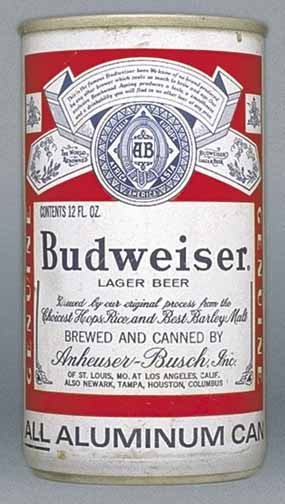
Budweiser Lager Beer Flat Top Can
Anheuser-Busch • Los Angeles, CA
Six-City Aluminum Budweiser Flat Top
This 12-ounce Budweiser flat top can represents a notable transitional phase in American beverage packaging. Fabricated with two-piece aluminum construction—as indicated by the "ALL ALUMINUM CAN" notice printed along its lower perimeter—the can was filled at the Anheuser-Busch plant in Los Angeles, California. A key defining feature is its mandatory brewery imprint: alongside the primary headquarters in St. Louis and the canning location in Los Angeles, the label cites Newark, Tampa, Houston, and Columbus. Because the Columbus, Ohio facility opened in 1968, this six-city variation dates to the late 1960s, an era when flat top cans were rapidly giving way to tab-opening alternatives.
Introduced in 1876 by Adolphus Busch and St. Louis merchant Carl Conrad, Budweiser was engineered as a Bohemian-style pale lager designed for national appeal. Busch incorporated rice alongside choice hops and barley malt while utilizing beechwood aging to produce a clean, uniform profile. Promoted famously under the enduring "King of Beers" slogan, Budweiser was backed by aggressive marketing that eventually elevated it to the best-selling beer brand in the United States.
Anheuser-Busch traces its roots to 1852 with the founding of the Bavarian Brewery in St. Louis. Soap manufacturer Eberhard Anheuser took control of the struggling business in 1860, and his son-in-law, Adolphus Busch, soon joined to propel its dramatic expansion. Busch revolutionized American brewing by embracing refrigerated railcars and pasteurization, establishing the nation's first true coast-to-coast distribution network. During Prohibition, the company survived by pivoting to baker's yeast, malt syrup, soft drinks, and refrigerated truck bodies. After Repeal, Anheuser-Busch built large regional breweries across the country—including Los Angeles in 1954 and Columbus in 1968—cementing its dominance through decades of post-war brewery consolidation.
For breweriana collectors, mandatory location variations on high-volume national brands provide a documented timeline of brewing history. Cans that reflect changes in city listings illustrate the post-war decentralization of national brewing giants. In addition, this all-aluminum example holds appeal among flat top enthusiasts because it captures the brief crossover period between emerging lightweight aluminum can manufacturing and the twilight years of flat top packaging.
* Descriptions are AI-assisted and may include edits from our team. Verify key details.
Can Details
Similar Cans
Price History
Not enough sales data to display a chart.
Sold Listings
No recent sales data available for this can.