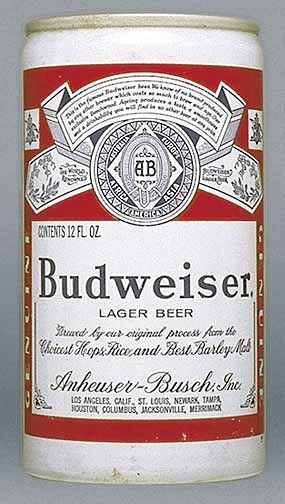
Budweiser Lager Beer Flat Top Can
Anheuser-Busch • Los Angeles, CA
Budweiser Los Angeles 8-City Flat Top
This 12-ounce flat top can represents an important phase in Anheuser-Busch’s post-war national expansion. Bearing the classic Budweiser heraldic layout, the label features the traditional Anheuser-Busch crest, the historic creed detailing the company's proprietary beechwood aging method, and the ingredients panel highlighting hops, rice, and barley malt. Below the company signature, the mandatory text lists eight production locations, with Los Angeles, California, placed in the leading position followed by St. Louis, Newark, Tampa, Houston, Columbus, Jacksonville, and Merrimack. The inclusion of Merrimack reflects the operational timeline established after the opening of that New Hampshire facility in 1970.
Adolphus Busch and St. Louis liquor merchant Carl Conrad introduced Budweiser in 1876 as a clean, Bohemian-style lager tailored to American tastes. Backed by early adoption of pasteurization, refrigerated railcars, and regional supply depots, Budweiser became one of the country's first true coast-to-coast beers. Long marketed under the iconic slogan "The King of Beers," the brand rose to dominate the American brewing landscape throughout the twentieth century before becoming the flagship label of a global beverage enterprise.
The brewery itself began in St. Louis, Missouri, where Eberhard Anheuser purchased a struggling facility in 1860 and subsequently partnered with his son-in-law, Adolphus Busch. Anheuser-Busch successfully survived Prohibition through industrial diversification, manufacturing baker's yeast, corn products, refrigerated cabinets, and non-alcoholic beverages. Following repeal in 1933, the company embarked on an ambitious program of regional decentralization, opening major brewing facilities across the United States, including the Los Angeles plant in 1954. The company remained under Busch family stewardship for generations until its eventual merger into Anheuser-Busch InBev.
For breweriana collectors, flagship cans from this transitional period offer a clear view into corporate history. Enthusiasts specifically seek out variations in mandatory city lines, which document the rapid expansion of brewing plants throughout the mid-twentieth century. Cans bearing specific plant leads like Los Angeles serve as vital markers for documenting the regional distribution networks of America's largest brewing houses.
* Descriptions are AI-assisted and may include edits from our team. Verify key details.
Can Details
Similar Cans
Price History
Not enough sales data to display a chart.
Sold Listings
No recent sales data available for this can.