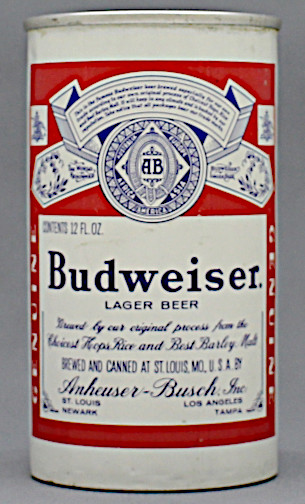
Budweiser Lager Beer Flat Top Can
Anheuser-Busch • St. Louis, MO
Budweiser Four-City Aluminum Can
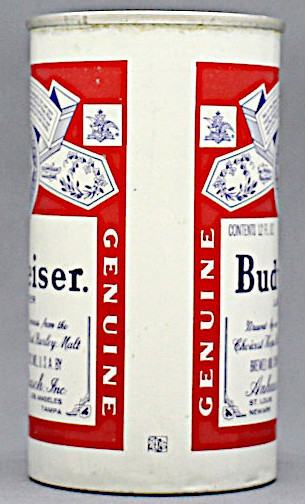
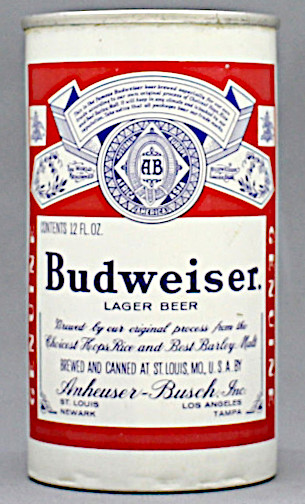
This twelve-ounce Budweiser Lager Beer can represents a notable milestone in mid-century packaging history: the beverage industry's transition toward lightweight, all-aluminum flat top construction. The front of the can presents the traditional red, white, and blue label artwork centered around the historic Anheuser-Busch crest, surrounded by traditional scrollwork and the signature brewing statement. Notably, the mandatory text at the bottom records Anheuser-Busch's mid-century manufacturing expansion, listing four distinct production cities: St. Louis, Missouri; Newark, New Jersey; Los Angeles, California; and Tampa, Florida.
Introduced in 1876 by Adolphus Busch and his associate Carl Conrad, Budweiser was crafted as a Bohemian-style pale lager designed for broad appeal across America. Unlike the heavier, darker ales common in the nineteenth century, Budweiser incorporated rice alongside choicest barley malt and hops to achieve a lighter, crisper finish. Busch pioneered the use of pasteurization and refrigerated railcars to ship the beer nationwide, establishing Budweiser as one of the country's first truly national beer brands. Positioned famously as "The King of Beers," the brand secured enduring popularity through widespread advertising campaigns and iconic promotional imagery.
The roots of Anheuser-Busch trace back to 1852 with the founding of the Bavarian Brewery in St. Louis. Eberhard Anheuser gained control of the business in 1860, joined shortly thereafter by his son-in-law Adolphus Busch, leading to the adoption of the Anheuser-Busch name in 1879. The company demonstrated remarkable resilience during Prohibition by diversifying into commercial yeast, malt syrup, refrigerated cabinets, and non-alcoholic beverages. Following the repeal of the Eighteenth Amendment, Anheuser-Busch initiated an aggressive nationwide expansion, opening state-of-the-art regional breweries across the country to maintain fresh distribution. By the late twentieth century, it stood as the largest brewing operation in the world.
Within breweriana collecting, this can is an essential study in container development and corporate evolution. In addition to marking the mid-century metallurgical shift to aluminum cans, the mandatory plant listings allow collectors to trace the chronological history of Anheuser-Busch’s post-war production facilities.
* Descriptions are AI-assisted and may include edits from our team. Verify key details.

Can Details
Similar Cans
Price History
Not enough sales data to display a chart.
Sold Listings
No recent sales data available for this can.