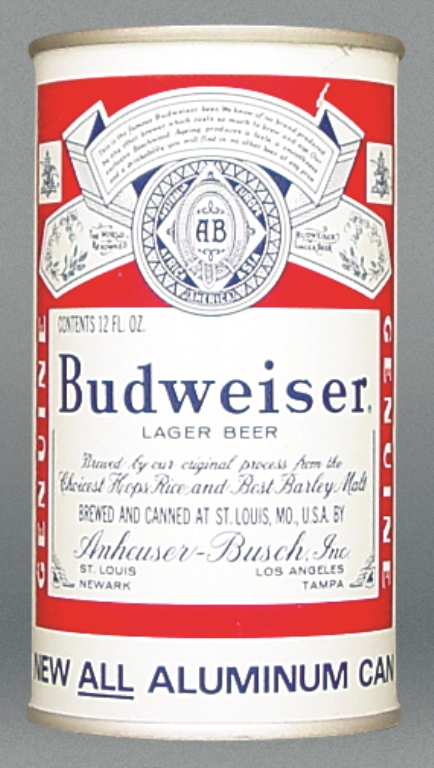
Budweiser Lager Beer Test Can
Anheuser-Busch • St. Louis, MO
Budweiser All-Aluminum Test Can
This 12-ounce Budweiser Lager Beer test can represents a fascinating experimental phase in mid-twentieth-century beverage packaging. While the lower banner boldly proclaims "NEW ALL ALUMINUM CAN," this test specimen was actually manufactured with straight steel construction and finished with a tab top. The front label lists four Anheuser-Busch production cities: St. Louis, Newark, Los Angeles, and Tampa. The artwork displays the traditional Budweiser package design, centered by the "A&B" crest, surrounded by circular continental medallions, and framed with the signature scroll detailing the brand's beechwood aging process.
Introduced in 1876 by Adolphus Busch and merchant Carl Conrad, Budweiser was developed as an easy-drinking, Bohemian-style lager designed for nationwide appeal. Positioned as a premium beer and marketed under the famous "King of Beers" moniker, Budweiser distinguished itself through a recipe blending rice with barley malt and hops. Backed by monumental advertising campaigns, iconic slogans, and ubiquitous sports sponsorships, Budweiser grew into an American cultural mainstay and one of the best-selling beer brands in the world.
Anheuser-Busch traces its roots to St. Louis, Missouri, beginning in the 1850s when Eberhard Anheuser acquired a struggling local brewery and was later joined by his son-in-law, Adolphus Busch. The company revolutionized the brewing industry by adopting pasteurization and operating a fleet of refrigerated railcars to build a truly national market. The brewery survived Prohibition by diversifying into commercial yeast, soft drinks, and refrigeration supplies, emerging poised for rapid postwar growth. In the decades that followed, Anheuser-Busch built regional facilities across the country—including sites in Newark, Los Angeles, and Tampa—before becoming part of the global brewing giant AB InBev.
Prototype and test cans are avidly sought by breweriana collectors because they document the developmental stages behind industry-wide packaging revolutions. During the 1960s, American breweries raced to adopt lighter metals and convenient pull tabs. The ironic contrast of a steel-bodied can advertising an all-aluminum format offers tangible evidence of trial marketing and factory proofing during this transformative period.
* Descriptions are AI-assisted and may include edits from our team. Verify key details.
Can Details
Similar Cans
Price History
Not enough sales data to display a chart.
Sold Listings
No recent sales data available for this can.