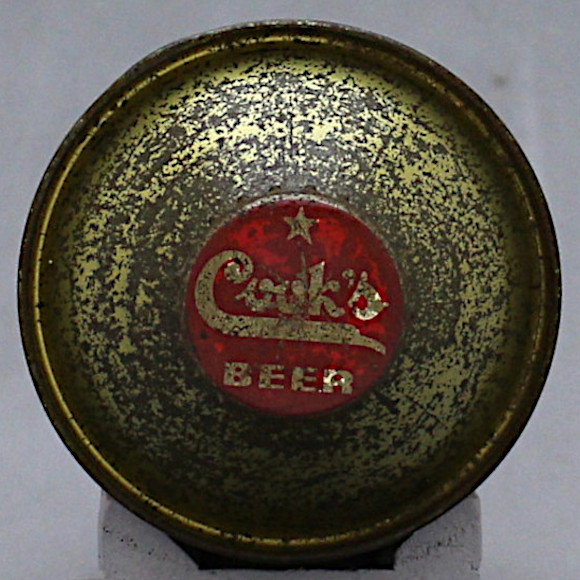
Cook's Goldblume Beer Cone Top Can
F.W. Cook • Evansville, IN
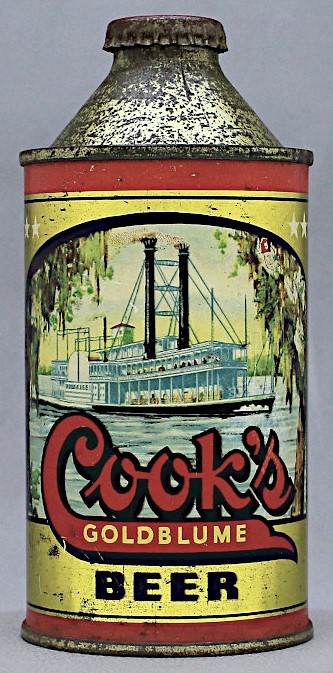
Cook's Goldblume Steamboat Cone Top
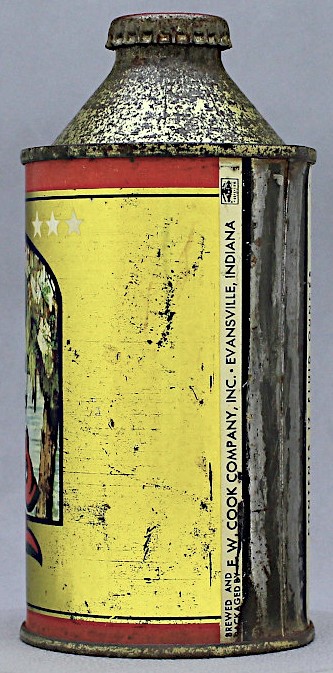
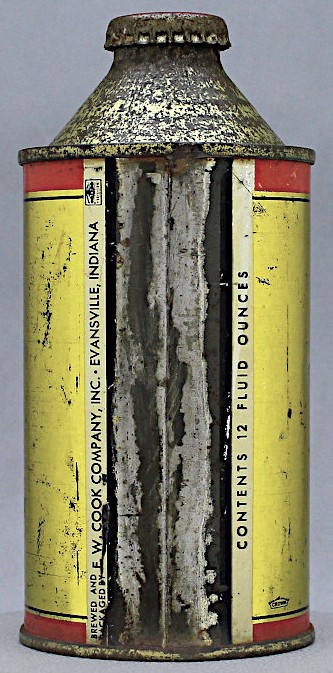
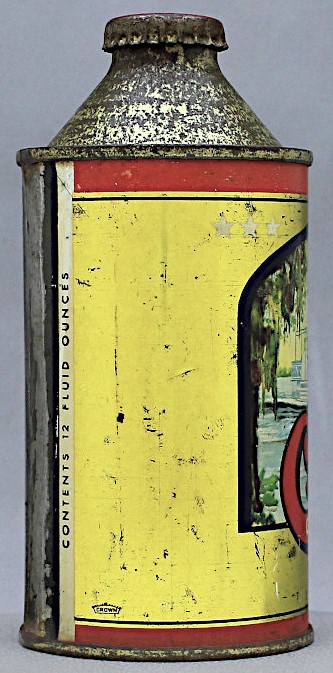
This 12-ounce high-profile cone top can showcases one of the most distinctive scenic illustrations found on mid-twentieth-century canned beer. Framed inside an arched vignette flanked by clusters of stars, the central artwork depicts a classic multi-deck paddlewheel steamboat navigating a river bordered by trees trailing Spanish moss. A key identifying detail on this specific can is the vessel name "ROBT. E. LEE" lettered across the paddlewheel housing, along with thin red accent lines bounding the upper and lower edges of the yellow label band. While related editions from the brewery display alternative vessel names or altered border rules, this issue pays direct pictorial tribute to the legendary nineteenth-century packet boat famed for its historic river races along the waterways that linked Evansville to the American South.
Cook's Goldblume was the premier flagship label of the brewery, introduced in the late nineteenth century as an homage to traditional German lager craft—with "Goldblume" translating to "gold flower," symbolizing fine hop blossom quality. Marketed extensively throughout the Midwest and South from the Great Lakes to the Gulf Coast, Goldblume was positioned as an everyday premium beverage. The brand enjoyed extensive promotion through radio broadcasts, print advertisements, branded tavern displays, and local sports sponsorships, including a regional semi-pro baseball team. However, postwar expansion by national brewing giants steadily eroded regional shelf space, and the brand vanished when the plant halted production in the mid-1950s.
The F.W. Cook brewing heritage began in 1853 when German immigrant Frederick Washington Cook and his partner Jacob Rice founded the City Brewery in Evansville, Indiana. Ideally located along the Ohio River transit corridor, the firm quickly grew into one of the state's largest industrial brewing complexes. After overcoming devastating facility fires in 1891 and 1905, Cook rebuilt modern facilities and weathered Prohibition by pivoting into soft drinks and commercial refrigeration. Reopening promptly upon Repeal, the company modernized its packaging lines and resumed wide distribution, but post-World War II consolidation, corporate changes, and prolonged labor strikes ultimately led to its closure in 1955.
Among breweriana collectors, Cook's cone tops bearing scenic transport motifs occupy a celebrated niche. The combination of detailed pictorial lithography, regional riverboat lore, and subtle vessel-name variations makes this can a centerpiece within mid-century cone top collections.
* Descriptions are AI-assisted and may include edits from our team. Verify key details.
Can Details
Similar Cans
Price History
Not enough sales data to display a chart.
Sold Listings
No recent sales data available for this can.