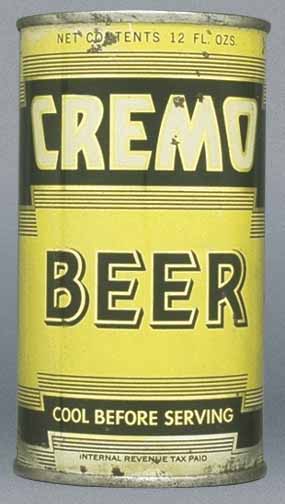
Cremo Beer Flat Top Can
Grace Bros LTD. • Los Angeles, CA IRTP era, 1935 to 1950
Prewar Los Angeles Cremo Beer
This 12-ounce flat top container originates from the late 1930s Internal Revenue Tax Paid era. Notable as an opening-instruction issue cataloged alongside early instructional cans from the period, the face features sharp Art Deco styling defined by horizontal speed-line bands framing the central lettering. Directly beneath the lower framing band, it presents a "Cool Before Serving" advisory positioned immediately above the mandatory "Internal Revenue Tax Paid" text along the bottom rim.
Cremo Beer served as an accessible, popular-priced lager distributed across California following the repeal of Prohibition. Positioned to provide everyday refreshment for working-class patrons navigating the lean economic years of the late Great Depression, the brand delivered straightforward appeal without elaborate ornamentation. Grace Bros. produced Cremo out of both Northern and Southern California plants during the late 1930s, though production under the Los Angeles banner concluded in the early 1940s as the onset of World War II prompted federal metal conservation orders and redirected brewery focus toward primary labels.
The Grace family initially built their brewing enterprise in Northern California when brothers Joseph and Frank Grace acquired a Santa Rosa facility in the late 1890s. Operating successfully for decades, the company survived Prohibition through commercial ice production and cold storage warehousing. Following Repeal, Grace Brothers mounted an ambitious statewide expansion, steadily growing into one of the largest brewing operations in California. In April 1937, the firm established its Southern California footprint by acquiring the Rio Brewing Company plant on South Rio Street in Los Angeles, operating it under Grace Bros. Ltd. The Los Angeles facility produced an assortment of regional and proprietary beers, competing vigorously against rival West Coast operations until post-war industry consolidation forced the plant's restructuring and eventual closure in the 1950s.
Prewar cans from West Coast facilities hold significant appeal among breweriana collectors. Because canned packaging was still emerging in the late 1930s, cans bearing opening instructions and the pre-1950 tax statement document an important transitional chapter in commercial design and regional packaging. The Los Angeles packaging run for Cremo highlights the brief era in which Grace Bros. maintained dedicated Southern California canning operations, making it a valued artifact of California brewing heritage.
* Descriptions are AI-assisted and may include edits from our team. Verify key details.
Can Details
Similar Cans
Price History
Not enough sales data to display a chart.
Sold Listings
No recent sales data available for this can.