Gretz Beer Quart
Wm. Gretz • Philadelphia, PA IRTP era, 1935 to 1950
Philadelphia's Classic Gretz Quart
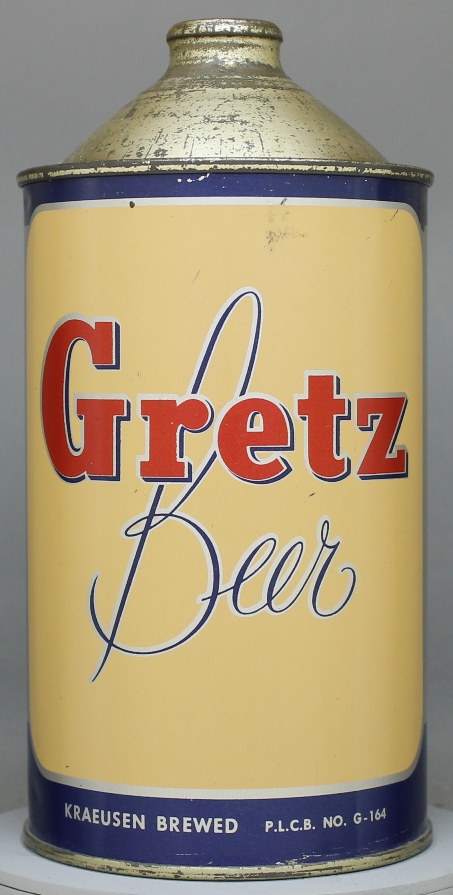
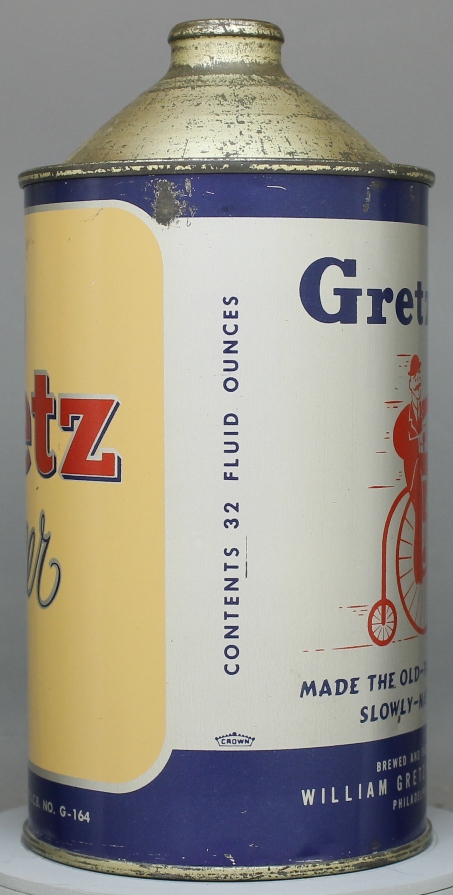
This 32-ounce quart cone top can represents a classic mid-century package from the William Gretz Brewing Company of Philadelphia, Pennsylvania. Produced during the Internal Revenue Tax Paid (IRTP) era, this oversized container features a distinct two-tone design centered around bold red "Gretz" block lettering intertwined with sweeping script text. Along the lower blue band, the can highlights the traditional brewing process with the phrase "Kraeusen Brewed" alongside the official state registration marking, "P.L.C.B. NO. G-164."
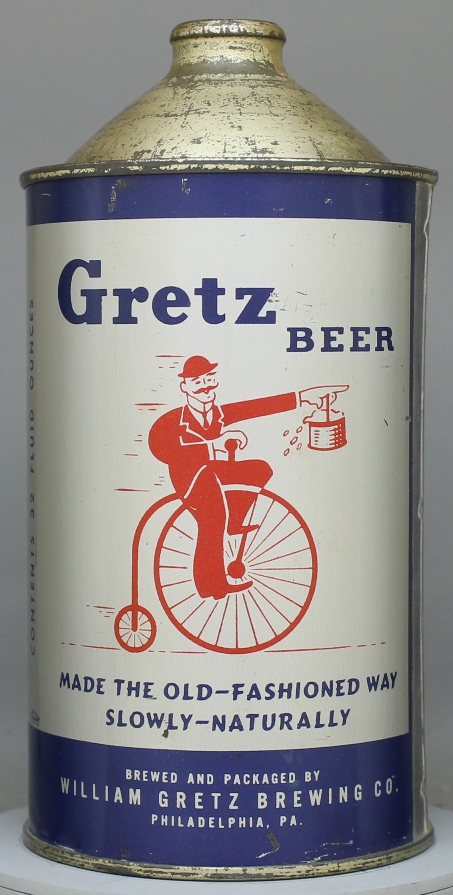
Gretz positioned its flagship beer around slow, time-honored brewing craftsmanship, emphasizing the German kräusen technique of adding fermenting wort to achieve natural carbonation and clarity. The brewery supported this approach with prominent regional advertising campaigns centered on the tagline "Made the old-fashioned way… slowly… naturally." The company became well known across the Delaware Valley for energetic marketing, running teaser billboards, sponsoring local sports and bowling teams, and backing community entertainment such as the televised "Gretz Cavalcade of Girls" pageant. Through heavy promotion of packaged beer for home enjoyment, Gretz emerged as one of the most widely consumed local lagers throughout the 1940s and early 1950s.
The brewery's origins trace back to 1881, when German immigrant William Gretz partnered with Leonard and Frank Rieger to establish the Rieger & Gretz Brewery at Germantown and Oxford streets. Following the repeal of Prohibition, the operation reorganized in 1933 as the William Gretz Brewing Company. By embracing modern canning technology early and focusing heavily on regional distribution, Gretz managed to outlast dozens of neighborhood competitors, reaching peak production in the late 1940s. However, the rise of heavily advertised national brewing conglomerates during the 1950s eventually squeezed local producers, leading to the brewery's closure in 1961.
Large-format quart cone top cans hold an important place in breweriana history. Because 32-ounce cans were filled in significantly smaller volumes than standard 12-ounce containers, surviving examples are particularly celebrated by collectors for their visual scale, bold graphic styling, and connection to Philadelphia's mid-century brewing legacy.
* Descriptions are AI-assisted and may include edits from our team. Verify key details.
Can Details
Similar Cans
Price History
Not enough sales data to display a chart.
Sold Listings
No recent sales data available for this can.