Lucky Lager Age Dated Beer Pint Can
Lucky Lager • Azusa, CA
Lucky Lager 16 oz Azusa Flat Top
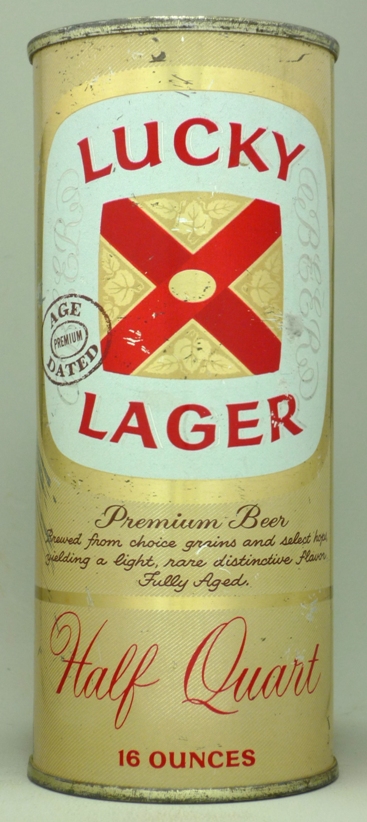
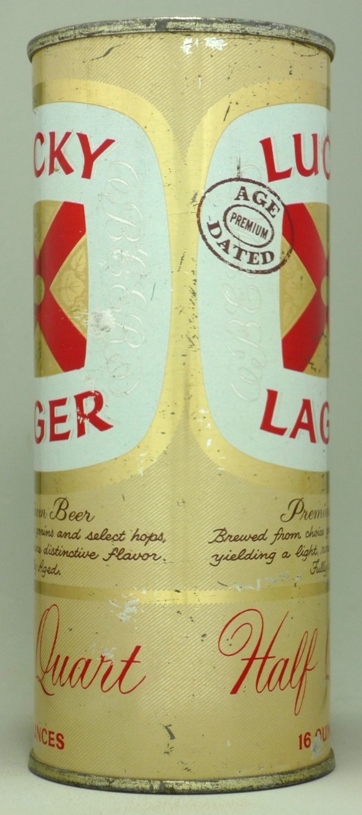
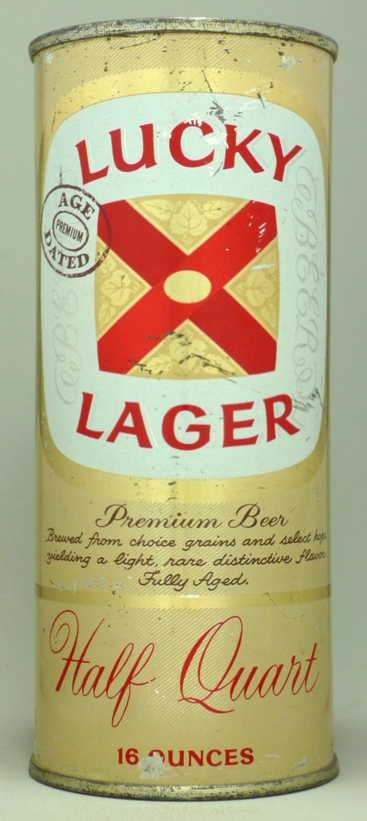
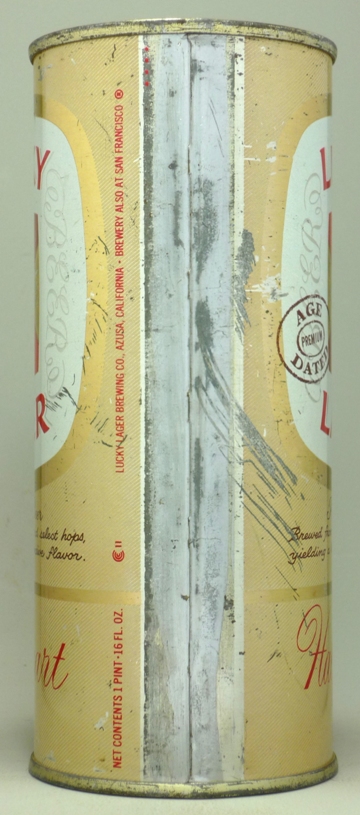
This 16-ounce flat top represents Lucky Lager's mid-century "Half Quart" packaging, produced at the company's Azusa, California facility. Standing out among flat tops of the era for its pint capacity, the can features the brand's bold red "X" insignia set against patterned gold quadrants, with large red script designating it as a "Half Quart" above a bold "16 OUNCES" volume declaration. A circular "Age Dated" seal is stamped to the lower left of the primary shield emblem. Cans of this print run are classified by their two-city mandatory statement, which documents Lucky Lager's multi-plant production network across the Pacific coast.
Lucky Lager was introduced in 1934 by San Francisco businessman Eugene Selvage shortly after the repeal of Prohibition. Formulated by brewmaster Julius Kerber to deliver a light, German-style lager, the brand became one of the dominant beers of the American West. Its advertising leaned heavily on the lagering process, introducing the "Age-Dated" marketing campaign that stamped packaging to certify full maturation. Paired with campaigns like Lucky Lager Dance Time radio broadcasts, the brand expanded aggressively through the 1940s and 1950s. By the 1960s, shifting consumer preferences and national competition eroded market share, leading to corporate reorganizations and eventual brand consolidation.
The Lucky Lager Brewing Company originally began as General Brewing Corporation in San Francisco in 1934, officially adopting the brand's name in 1948. To meet surging postwar demand in Southern California, the company opened a state-of-the-art regional facility in Azusa in 1949. Alongside plants in Vancouver, Washington, and Salt Lake City, Utah, Azusa supplied the booming regional market through the 1950s. Rising operational pressures during the mid-1960s led to the sale of the Azusa facility to the Miller Brewing Company in 1966, while remaining brewing interests folded into General Brewing under financier Paul Kalmanovitz.
Among breweriana collectors, mid-century pint flat tops hold strong interest due to their larger proportions compared to standard 12-ounce cans. The subtle placement differences of the "Age-Dated" medallion, variations in canning codes, and differing combinations of branch cities create distinct varieties that document the postwar footprint of West Coast regional brewing.
* Descriptions are AI-assisted and may include edits from our team. Verify key details.
Can Details
Similar Cans
Price History
Not enough sales data to display a chart.
Sold Listings
No recent sales data available for this can.