Pabst Export Beer Flat Top Can
Premier-Pabst • Milwaukee, WI IRTP era, 1935 to 1950
Pabst Export Beer Flat Top Can
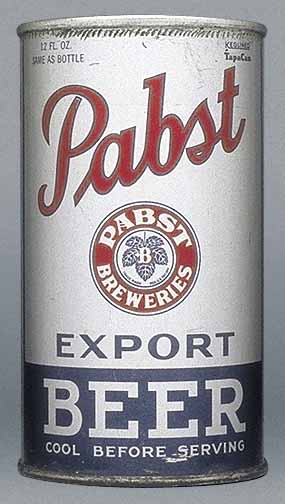
Produced during the Premier-Pabst era of the 1930s, this twelve-ounce flat top can represents an early chapter in the commercial adoption of beer in cans. The container carries an "OT" tax statement and is distinguished by two brewery city listings alongside the American Can Company "KEGLINED TapaCan" emblem at the upper right. Text at the upper left reassures consumers with "12 FL. OZ. SAME AS BOTTLE," while the lower rim instructs drinkers to "COOL BEFORE SERVING" beneath bold block lettering. The front panel balances the flowing Pabst script with the circular "PABST BREWERIES" hop-and-leaf trademark. In breweriana reference catalogs, researchers note that this specific entry may represent a duplicate record of an adjacent listing and could eventually be consolidated.
Pabst Export was introduced as a premier packaged offering in the wake of Repeal. When canned beer emerged in 1935, Pabst moved aggressively into the new format, becoming the second American brewing company to bring canned beer to market. Rather than treating the can as generic packaging, the company vigorously branded its vessel as the "TapaCan," mounting an extensive promotional campaign around the slogan "Brewery Goodness Sealed Right In". Advertisements heavily emphasized the patented "Keglined" interior coating, reassuring consumers that the polymer lining protected flavor and prevented any metallic taste. As packaging technology normalized and national marketing consolidated, Pabst gradually phased out the standalone Export moniker in favor of its world-famous Blue Ribbon identity.
The brewery traces its heritage to 1844, when Jacob Best established the Empire Brewery in Milwaukee, Wisconsin. Under the leadership of Captain Frederick Pabst, who married Best's daughter and took over management, the operation grew into an industrial powerhouse and was renamed the Pabst Brewing Company in 1889. By 1892, it stood as the largest brewing company in the country. To endure Prohibition, the company survived on near-beer, processed cheese, and malt extracts, eventually merging with Premier Malt Products in 1932 to form Premier-Pabst Corporation. In 1938, the business reverted to its traditional Pabst Brewing Company name. Decades of intense post-war expansion followed before industry upheaval led to the closure of the historic Milwaukee plant in 1996.
For collectors of pre-war flat tops, this can represents a landmark artifact. It documents the formative years of canned beer packaging, the high-stakes introduction of the TapaCan system, and the evolving corporate structure of a historic American brewing giant.
* Descriptions are AI-assisted and may include edits from our team. Verify key details.
Can Details
Similar Cans
Price Statistics
Not enough sales on record to estimate this can's value. Estimates are built only from real auction results, and one lone sale isn't enough to go on.
Price History
Not enough sales data to display a chart.
Sold Listings
| Price | Title | Platform | Date |
|---|---|---|---|
| $350.00 | 111-11 Pabst Export | Steel Canvas | 10/20/2018 |