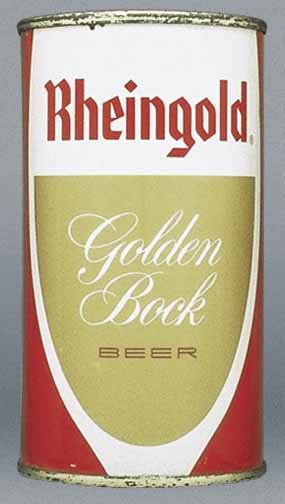
Rheingold Golden Bock Flat Top Can
Rheingold • Orange, NJ
Rheingold Golden Bock Flat Top History
This twelve-ounce flat top can represents Rheingold's seasonal spring release, produced out of the company's brewing facility in Orange, New Jersey. Dating from the early 1960s, the can features a gold-toned shield framing the flowing white script lettering of "Golden Bock" positioned beneath the brand's bold, blackletter "Rheingold" typography.
Rheingold introduced Golden Bock as a traditional late-winter and early-spring seasonal offering, heralding the turn of the calendar with promotional campaigns such as "Rheingold Golden Bock is back! (Can Spring be far behind?)". Originally introduced in the late nineteenth century, the Rheingold brand expanded to become a dominant force across the northeastern United States. During its mid-twentieth-century peak, the label commanded a tremendous share of the metropolitan regional market, propelled by high-profile advertising, broad sports sponsorships, and the wildly popular annual "Miss Rheingold" contest.
The beer was crafted by Liebmann Breweries (later officially renamed Rheingold Breweries, Inc.), an enterprise founded in Brooklyn, New York, by German immigrant Samuel Liebmann in 1854. The firm successfully navigated Prohibition by marketing near-beer and commercial malt extracts, re-emerging as a regional titan following Repeal. In 1950, seeking to expand production capacity to meet postwar demand, Liebmann acquired the former John F. Trommer brewing plant at 119 Hill Street in Orange, New Jersey. The Orange facility served as a major production hub for decades alongside the Brooklyn headquarters. However, mounting competition from expanding national macro-breweries and multiple corporate ownership transfers in the 1960s and 1970s precipitated a sharp decline, culminating in the closure of the Orange plant and the cessation of original operations.
Seasonal bock cans hold a prominent place within breweriana collecting. Because bock beers were packaged for only a limited window each year rather than sold continuously, their production quantities were significantly smaller than those of year-round pale lagers. For collectors focusing on New Jersey brewing history or mid-century regional giants, this can stands out as a distinguished artifact from the golden age of East Coast brewing.
* Descriptions are AI-assisted and may include edits from our team. Verify key details.
Can Details
Similar Cans
Price History
Not enough sales data to display a chart.
Sold Listings
No recent sales data available for this can.