Schlitz Ale Test Can
Jos. Schlitz • Milwaukee, WI
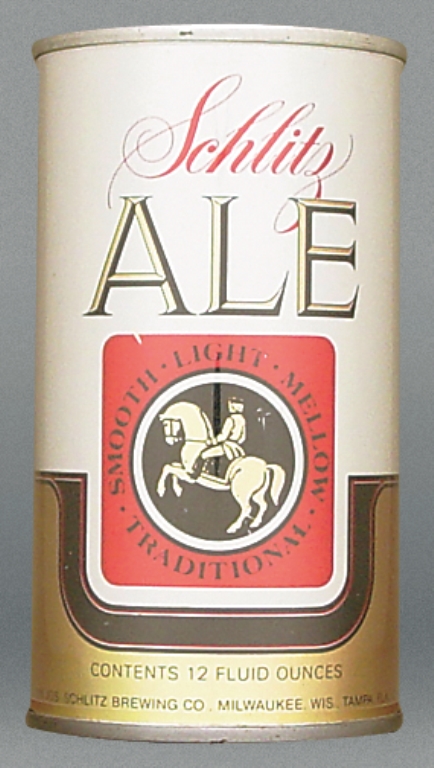
1976 Schlitz Ale Test Market Can
Produced in 1976, this straight steel tab-top can represents a limited regional market trial by the Jos. Schlitz Brewing Company. Distributed across a six-city test area, the can displays the familiar red Schlitz script above the bold "ALE" designation, anchored by an equestrian medallion ringed with the promotional descriptors "SMOOTH • LIGHT • MELLOW • TRADITIONAL." The lower label lists brewing locations in Milwaukee, Wisconsin, and Tampa, Florida, above the standard 12-fluid-ounce volume specification.
During the mid-1970s, Schlitz sought to diversify its portfolio beyond its world-renowned flagship lager and its popular Schlitz Malt Liquor. As the national brewing landscape evolved, large brewers tested specialty offerings to gauge broader consumer interest in alternative styles. Schlitz Ale was positioned to provide drinkers with a traditional ale character crafted in an approachable, smooth profile. Following these limited multi-city trials, however, the brand was not transitioned into full national distribution.
The Jos. Schlitz Brewing Company originated in 1849 when German immigrant August Krug founded a small brewery and restaurant in Milwaukee. Following Krug's death, bookkeeper Joseph Schlitz assumed control of operations and renamed the company. Schlitz grew rapidly through expanded rail distribution, eventually becoming the largest brewing company in the United States at the turn of the twentieth century and establishing its enduring motto, "The Beer That Made Milwaukee Famous." The brewery navigated Prohibition by selling cereal beverages and confections, reemerging to battle Anheuser-Busch for the country's top sales spot through the 1950s. Subsequent manufacturing changes in the 1970s harmed the flagship brand's reputation, contributing to declining sales that culminated in the company's acquisition by Stroh Brewery Company in 1982.
Among breweriana enthusiasts, test market containers are prized for documenting experimental product concepts and short-lived marketing campaigns. Because these cans were manufactured for brief consumer evaluations in restricted distribution zones rather than general commercial release, they represent fascinating historical snapshots of major brewing strategy during the 1970s.
* Descriptions are AI-assisted and may include edits from our team. Verify key details.
Can Details
Similar Cans
Price History
Not enough sales data to display a chart.
Sold Listings
No recent sales data available for this can.