Schlitz Beer Flat Top Can
Jos. Schlitz • Brooklyn, NY IRTP era, 1935 to 1950
1946 Schlitz Brooklyn Flat Top Can
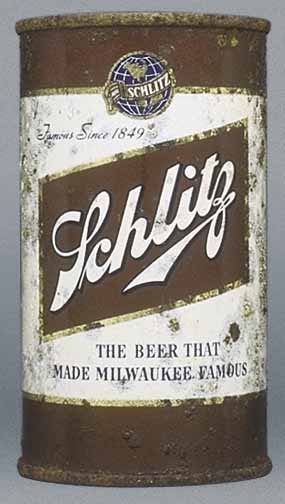
Dating to 1946, this twelve-ounce flat top can represents the immediate post-World War II era of civilian beer canning. It bears an Internal Revenue Tax Paid statement, a mandatory federal requirement on domestic malt beverage packaging between the repeal of Prohibition and 1950. Canned under the Jos. Schlitz Brewing Company's Brooklyn, New York designation, the label prominently displays the company's trademark belted globe crest, the notation "Famous Since 1849," a sharp diagonal band framing the script logo, and the renowned slogan, "The Beer That Made Milwaukee Famous".
Schlitz earned its legendary status largely through opportune distribution following the Great Chicago Fire of 1871, when the brewery dispatched relief shipments of fresh water and beer southward to aid the devastated city. That act gained widespread acclaim, solidifying consumer loyalty across the Midwest and directly inspiring its famous civic catchphrase. Marketed heavily as a premium, pristine American lager, Schlitz rose through aggressive mid-century advertising on radio, television, and print to become one of the top-selling beer brands in the nation, frequently trading the number-one sales position with Anheuser-Busch during the postwar decades.
The Joseph Schlitz Brewing Company had its beginnings in 1849 when August Krug established a small brewery in Milwaukee, Wisconsin. After Krug's death, bookkeeper Joseph Schlitz took charge of operations, later renaming the enterprise. Schlitz survived Prohibition by pivoting to non-alcoholic beverages, yeast, and malt syrups, allowing it to rapidly restore brewing capacity once repeal arrived. As part of its postwar expansion to service East Coast markets efficiently, the company operated regional production out of Brooklyn. Schlitz remained an industry titan until changing business conditions and internal restructuring led to its purchase by the Stroh Brewery Company in 1982, after which the brand rights eventually transferred to the Pabst Brewing Company.
Flat top cans from the immediate postwar period carry significant historical value for breweriana enthusiasts, capturing the pivotal transition when breweries returned to commercial canned packaging. Examples from national giants bearing specific metropolitan bottling locations offer collectors valuable insight into the regional distribution networks that defined mid-twentieth-century brewing.
* Descriptions are AI-assisted and may include edits from our team. Verify key details.
Can Details
Similar Cans
Price History
Not enough sales data to display a chart.
Sold Listings
No recent sales data available for this can.