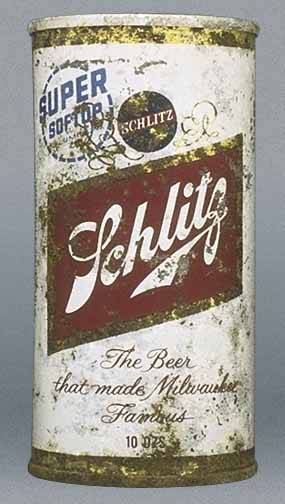
Schlitz Beer Flat Top Can
Jos. Schlitz • Milwaukee, WI
Schlitz 10 oz Super Softop Flat Top
Dating to 1960, this 10-ounce flat top can represents a pivotal transitional moment in mid-century beer packaging. Emblazoned in the upper-left corner is the circular "Super Softop" emblem, promoting the brewery's adoption of easier-to-pierce aluminum lids fitted onto traditional steel can bodies. The front face features the iconic angled red Schlitz banner alongside the legendary script slogan, "The Beer that made Milwaukee Famous," with the "10 OZS." volume statement positioned cleanly along the lower front edge.
Schlitz was one of the most recognizable and dominant brands in American brewing history. Originally marketed as a premium, pure lager, the brand developed some of the most enduring advertising campaigns in consumer goods. Its defining tagline, "The Beer that made Milwaukee Famous," took hold after the 1871 Great Chicago Fire, when Schlitz sent trainloads of free beer to aid the stricken city. In later decades, memorable marketing slogans like "When you're out of Schlitz, you're out of beer" and "Go for the Gusto" solidified the brand in mid-century American culture.
The Jos. Schlitz Brewing Company traces its roots to 1848, when August Krug established a small brewery in Milwaukee, Wisconsin. Following Krug's passing, his bookkeeper Joseph Schlitz took over management, eventually renaming and incorporating the firm in 1873. After Schlitz died at sea in 1875, management passed to the Uihlein family, who oversaw expansive growth for over a century. The brewery survived Prohibition by manufacturing malt extract, beverages, and confections, emerging ready to compete for national supremacy. By the 1950s and 1960s, Schlitz regularly traded places as the largest brewer in the United States before brand changes and industry consolidation led to its 1982 acquisition by Stroh, with the label eventually joining the Pabst portfolio.
For vintage can collectors, pre-1970 10-ounce cans represent an engaging and challenging collecting focus. While 12-ounce containers accounted for the vast majority of canning volume, fractional and specialty sizes were manufactured in much smaller runs. Furthermore, the explicit "Super Softop" labeling captures the rapid evolution of can engineering during the dawn of the 1960s.
* Descriptions are AI-assisted and may include edits from our team. Verify key details.
Can Details
Similar Cans
Price History
Not enough sales data to display a chart.
Sold Listings
No recent sales data available for this can.